














For much of the 20th century, Venezuela and the United States maintained strong political and economic standing, largely based on U.S. desire for oil present in Venezuela. However, changes in Venezuelan leaders and U.S. foreign policy have gradually shifted their relationship into one of tension and violence.
Timeline
Tension between Venezuela and the U.S. began to worsen after the death of authoritarian president Hugo Chavez who was president of Venezuela from 1999 until his death in 2013. Chavez was largely responsible for leveraging Venezuela’s oil reserves and worsening Venezuela’s dependence on oil exports from 71 percent to nearly 98 percent in 2013 according to Global Conflict Tracker. After his death, acting President Nicolás Maduro narrowly defeated his opponents to become the next president.
Maduro’s presidency was largely defined by his effort to consolidate his authority and maintain power in the face of public outrage. He worked throughout his time in office to suppress protest and restrict freedom of speech and assembly.
In 2014, 43 people were killed in an attack between pro-Maduro forces and student-led protesters concerned about the rising crime rates. This is just one example of countless government sanctioned attacks aimed to suppress the voices of the public ordered by Maduro.
Research from Congress found that in 2017, Maduro further consolidated his power by appointing Tareck El Aissami as vice president, a U.S.-designated drug kingpin who assisted Maduro in restricting freedom of speech. In that same year, he convened a constituent assembly to rewrite the constitution to no longer require a popular referendum to hold office which was wildly unpopular and was seen as an attempt by Maduro to remain in office no matter how the public voted.
After being re-elected in 2018, the U.S., the European Union, and many neighboring countries decided to no longer recognize Maduro as Venezuela’s president in 2019 following his reelection that many deemed fraudulent. Despite countless boycotts and fraudulent elections, Maduro would continue being re-elected and would remain in office until 2026.
U.S Policy
Following the U.S. government’s decision to cease recognizing Maduro as Venezuela’s president, many presidents have worked to place pressure on Maduro and his supporters to leave office.
It’s important to understand not only who Maduro is, but how he remains so resilient despite worldwide efforts to restrict him. According to Congress, “For years, military leaders and other officials have enriched themselves through corruption, drug trafficking, and other illicit industries.” Maduro has built a network of security that hides corruption and illegal activity by paying off military leaders and forcing their silence.
Throughout his time in office, Maduro has used force to detain his critics including human rights journalists, politicians, and military officers. Many opponents of Maduro have been detained and held in inhumane conditions without access to counsel and have been subject to torture for crimes without evidence according to Congress.
U.S foreign policy has largely aimed to provide humanitarian aid to citizens within Venezuela as well as provide sanctions to inhibit Maduro’s authoritarian rule. Such sanctions have targeted oil shipments, which Venezuela heavily rely on for economic growth.
One such humanitarian crisis occurred in 2019, where thousands of civilians fled the country due to poor infrastructure, which was leading to national blackouts, leaving millions without power. In addition, Venezuela suffered from severe food and medicine shortages, which greatly contributed to the spread of disease. According to Global Conflict Tracker, “after years of denying the existence of a humanitarian crisis and refusing to allow foreign aid to enter the country… Venezuelan President Nicolás Maduro allowed the entry of a shipment of emergency supplies from the Red Cross.”
It’s clear that Venezuela’s government has largely ignored the needs of the people and focused on maintaining power in the face of foreign tension. It’s these factors that have contributed most to the current relationship between Venezuela and the U.S.
Current Events
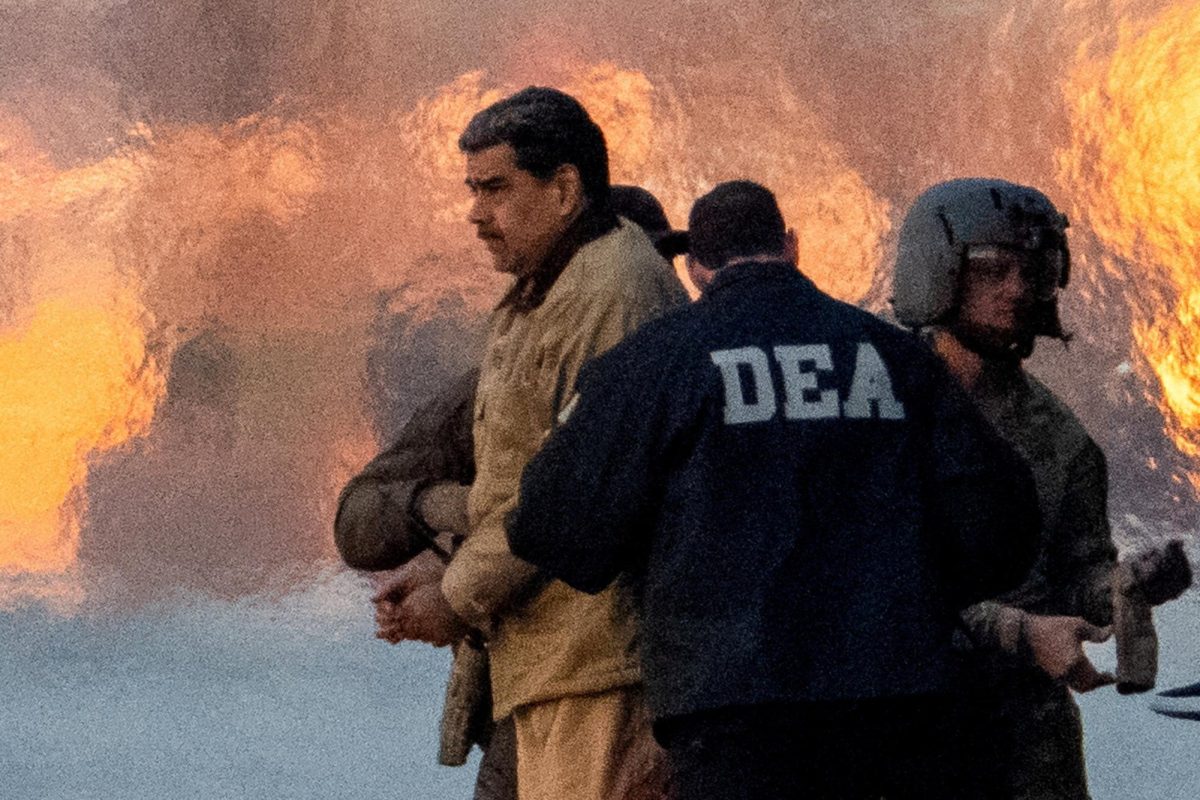
Due to tensions between the United States and Venezuela, U.S. forces completed military operations in Venezuela in early January, resulting in the capture of the Venezuelan President Nicolás Maduro along with his wife. They were taken to the United States to face charges, according to U.S officials. The operation included airstrikes and planned military action, making history as one of the most forceful interventions by the U.S. military in political affairs.
President Donald Trump claimed that the United States would “run” Venezuela until the country is organized. He also stated that Washington would control the security of Venezuela during a “safe, proper, and judicious transition.” Trump has described this phase as a stable transition rather than a longer conflict.
For many Venezuelans and Venezuelan Americans, this news is very emotional. Senior Mari Snideman, whose family is originally from Venezuela, felt that the news was shocking but also exciting. “We take great pride in our country, and we are glad that a corrupted leader like Maduro has finally left, giving our country the chance to be able to develop and become better,” Snideman said. Ultimately, she is aware of the different opinions built around Venezuela and how the media portrays it, but she can see “how bad Venezuela really is right now.”
The U.S. has also come for Venezuela’s oil revenue streams, a major part of Caracas’s economy. The U.S. military and Coast Guard have taken large quantities of oil tankers connected to Venezuelan oil exports, a move designed to undermine Maduro’s administration and declare control over the oil operations.
Not only oil seizures, but also instability in the Venezuelan community is broad. Millions of Venezuelan migrants in Latin America are thinking about returning to their home, seeing hope and change, with some fear about the economic stability of Venezuela. Activists have also highlighted the importance of shifting to a democratic governance.
The Venezuelan government’s response has been resistant and defensive. They have called for social media actions to defend their integrity. Vice President Delcy Rodríguez engaged with U.S. officials attempting to negotiate who manages the oil revenue, even while reactions globally have varied.
What’s Next
Officials in Washington have said that economic reconstruction of oil investment and political transition efforts will be highly prioritized from now on. Maduro and his wife are being held in federal custody in New York City at the Metropolitan Detention Center, where they are awaiting trial facing drug trafficking, narco-terrorism, and conspiracy to import cocaine into the United States. So far in court, both he and his wife have pleaded not guilty to all of those charges. Their next scheduled court appearance is on March 17, 2026.


Ethan R. • Jan 30, 2026 at 11:56 AM
Very detailed and interesting. Thank you for using great details!
Will • Jan 23, 2026 at 11:35 AM
This article offers a very non-biased opinion on the U.S. Military’s operations in Venezuela. Great read.
cchasan • Jan 23, 2026 at 11:34 AM
I like how this is an unbiased yet informational view of this situation.
Derrick • Jan 23, 2026 at 11:34 AM
I like how specific dates, times, and numbers were used. It gave the article more detail and made it better to read